

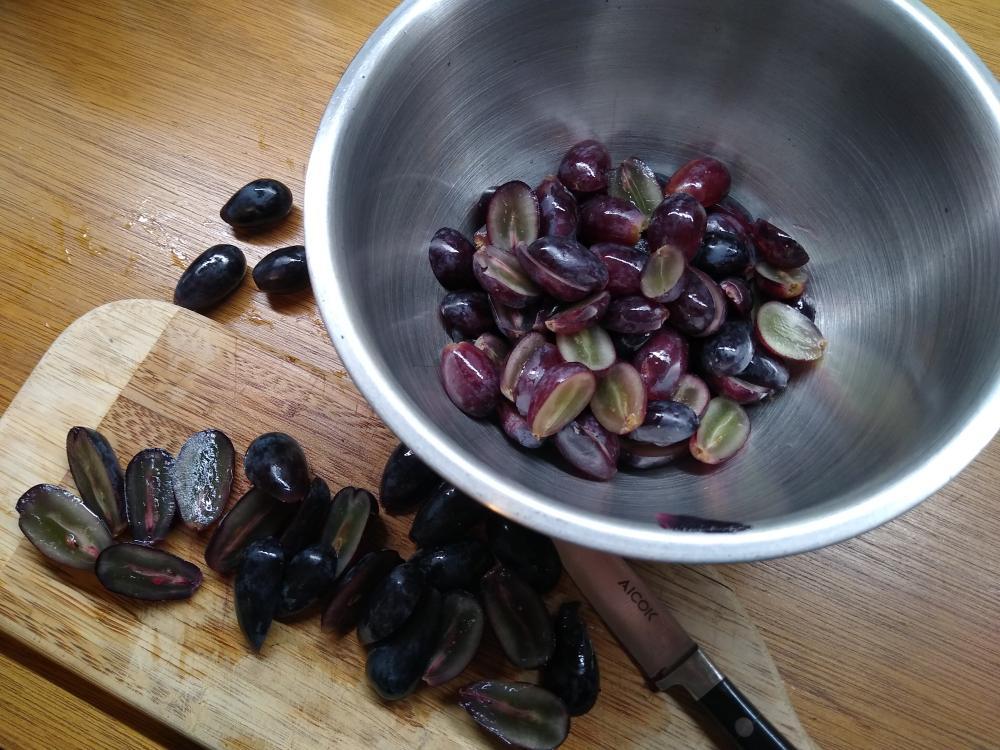
It's always the same heartbreaking story: You saw the luscious,seductive display of those opalescent orbs of jammy juiciness in the produce department, and you kinda lost control. The memory of smooth cold on your tongue, the way the skin resists slightly as you bite into it, then the flesh giving itself to you, shy but willing... You buy three cello bags, one in each color -- green, black, red -- all seedless, and a wedge of nice cheese, some crackers. *** They don't look as sexy in your refrigerator. *** Three days later, you have now eaten exactly 23 grapes and the cheese is gone. Another week goes by, and another. In the end, you must admit to yourself that it isn't working, and you must part ways. You tenderly remove the cello bags, in which the dull, moldy remains of the greatest love you have ever felt (recently) in a supermarket, wait for the inevitable, leaving a hole in your heart and your fridge. One day, another fruit will occupy those voids, maybe a honeydew or even a mango. Today, though, is for mourning and self-reflection. And compost. *** After some time has gone by, you may want to try again with grapes, and I want to help you have a more successful relationship this time around. All it takes is the right tools, and a little time! Almost everyone I know has a food dehydrator, lurking about in a closet or shed, usually one of those plastic stackable ones. I have one of those, and I recently purchased a used 6-tray Dehyber for $40. Now, when I lose my mind over some fresh little pieces of fruit, I have no qualms about picking them up and taking them home with me! Here's my "recipe" for Raisins d'etre: Before they get gray and wrinkly and lose your affection forever, wash your grapes and slice them in half. Place them, cut side down, on the dehydrator trays. (I like to make fun grape art with the different colored grapes on the tray.) The fancy Dehyber has temperature control and a timer, and I use the just-below-middle setting, around 145 degrees F. I set the timer on 12 hours, and go do other things. (In the other little dehydrator, nothing really changes, though you may want to check them more often, and don't forget your kitchen timer!) I start removing any that are at (my) optimal chewiness around ten hours. Use a small fork to gently pry them off the trays if needed. We use them in oatmeal, baked goods, and of course they're yummy healthy snacks all by themselves!